RECYCLING IDEAS
Why?
Recycling ideas is one of the fundamental and significant practices of human nature. It not only provides a sense of continuity and connection across various contexts, times, and places, but has also always been a source of inspiration for innovation and creativity. Why do so many cultures share a myth of a great flood that either destroys (or creates) the world? Why do invaders and occupiers build their new sanctuaries atop existing ones? Clearly, while the unfamiliar excites us, the familiar and well-known offer us comfort.
The original (about love) The Estonian version (about summer vacation and sauna)
Culture can be seen as the repetition of the same thoughts over and over: “The thing that hath been, it is that which shall be; and that which is done is that which shall be done: and there is no new thing under the sun” (Ecclesiastes 1:9). Interpretations of Greek plays, Bible-themed paintings, anecdotes, fairy tales, collages, meme culture on the internet, and remakes of old television series are just a few examples of recycling ideas. In contemporary culture, particularly within the visual arts, there is a prevalent aspiration to create something entirely new and original. The strong emphasis on individuality and uniqueness creates constant pressure. Why not view art as fragments or remakes of everything that has already been done—a collection, an archive of everything surrounding us?


In contrast to most Western paradigms, many African cultures embrace the philosophy of Ubuntu, often translated as “I am because we are.” This concept emphasizes our interconnectedness and the importance of living for and through one another. This perspective can also provide a refreshing way to rethink art: art is because it has been and continues to be. It exists through, for and in everything surrounding it.
As stated earlier: culture is a cycle of repetition, a bus route going from one side of the city to another every day, a pattern, a song, a dance: you can take it apart and look at the movements separately—and soon enough you will realise the insignificance, the pointlessness and ordinariness of them all. But you can also look at the whole choreography and way all the pieces are combined. I think this is the main job of an artist: to combine, to mix, to relate pieces of the world. It is not to come up with something new, but to pass on the already-existing energy. Just as the sea forms waves—but doesn’t produce them.
This is something that I have always tried to keep in mind in my own life: being creative means being attentive, observant and thoughtful. There is no such thing as given talent, but conscious willingness to see, hear, explore and understand. “To be the eyes and ears and conscience of the Creator of the Universe, you fool!” (Kurt Vonnegut, Breakfast of Champions). I believe that this attentiveness connects all great things ever made – and with this attentiveness, it doesn’t really matter, if you are building houses, writing novels, painting the domes of cathedrals or cutting hair. The inspiration is the same, the devotion is the same.

How?
EKA GD Studio is constantly producing misprints, unfinished projects, and excess paper. This is a normal part of design process. I believe that all these leftovers deserve at least one more cycle of life. It is not just about sustainability—though that is an equally important aspect—but also about valuing the time, input, and thought process behind the “trash.” The excess paper box can be a fantastic source of inspiration for anyone—material source, of course, for reusing the already printed images, texts etc, but also a stylistic, inspiration source, a place to seek for new ideas. To meet with information you would maybe never stumbled upon yourself.
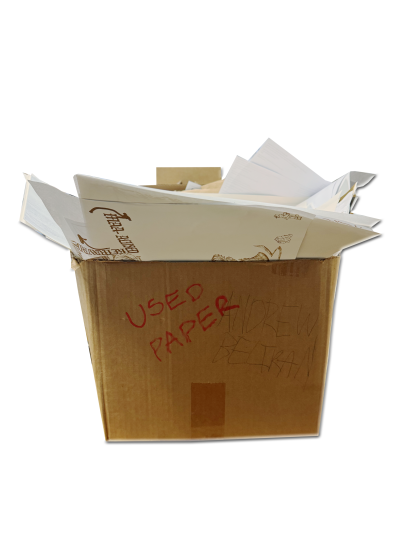

The process of going through the box is often just as creative and valuable as actually making something, and it is a conscious decision to step aside and take the role of an observer, a collector, a curator, rather than a creator. As found in Genesis: God created the universe out of a formless void—“tohu vav bohu” in Hebrew. Maybe, in order to create an Universe, the first step must be finding the “tohu vav bohu”. Maybe it's possible to find it from the paper trash in the studio. Maybe.

